
Case Study

Regional Command Center (RCC) Platform

Real-time Healthcare Coordination for 26 Hospitals

A government healthcare command center serving as the central coordination system for 26 hospitals in the Jazan region. It combines real-time WebSocket dashboards, RCC VoIP coordination workflows, a Leaflet/OpenStreetMap live GEO ambulance map, STEMI/Stroke/Trauma clinical portals, and KPI compliance reporting for Ministry stakeholders.

6/1/2025Updated 3/12/202612 min read
React
Redux
NestJS
Node.js
PostgreSQL
SQL
WebSocket
Leaflet
OpenStreetMap
TypeScript
Docker
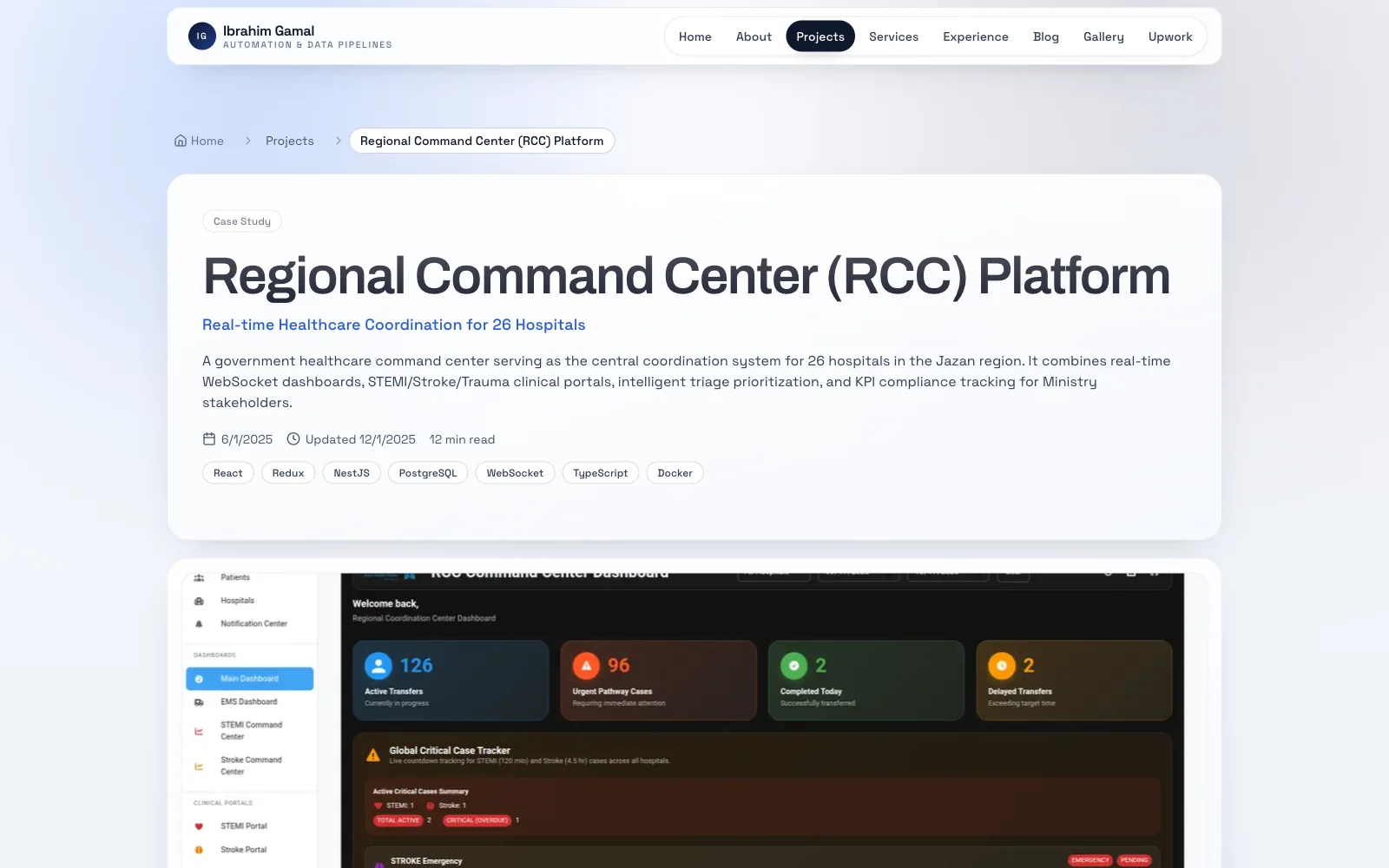
Regional Command Center (RCC) Platform screenshot

Project Overview

The Challenge

The Saudi Ministry of Health needed a centralized command center to coordinate emergency care across 26 hospitals in the Jazan region. Existing systems were siloed, using different data formats and legacy software, making it impossible to have real-time visibility into bed capacity, patient flow, and critical care metrics across the healthcare network. Government stakeholders required strict compliance with medical protocols and immediate access to KPI data for decision-making.

The Solution

I led the design, delivery, and ongoing enhancement of the Regional Command Center (RCC) Platform - a real-time web/database coordination system connecting all 26 hospitals. The platform features WebSocket-powered live dashboards for bed capacity and ambulance tracking, RCC VoIP coordination workflows, and an open-source Leaflet/OpenStreetMap GEO map with arrival estimation and operational notifications for hospital and ambulance teams. It also includes clinical portals for STEMI, Stroke, and Trauma pathways with multi-step workflows, KPI validation engines, and resilient data pipelines normalizing data from heterogeneous hospital systems.

Impact

  • Central nervous system for 26 hospitals enabling regional coordination
  • Real-time bed capacity visibility for patient transfer decisions
  • Open-source live GEO map for command-center ambulance tracking
  • Automated hospital and ambulance notifications for dispatch milestones
  • STEMI/Stroke/Trauma pathway compliance tracking with traffic-light KPI alerts
  • Intelligent ticket prioritization based on clinical vitals and urgency
  • 99.9% data accuracy from heterogeneous legacy hospital systems
  • Operational monitoring and reporting workflows for ministry-facing decision support
  • Reduced manual coordination overhead by 70% through automation
  • Tech Lead for a team of 5 engineers through full SDLC
  • Sole technical liaison between Ministry stakeholders and implementation team

Key Metrics

26

Hospitals Connected

Real-time data integration

99.9%

Operational Uptime

Continuous command-center availability

+70%

Coordination Efficiency

Manual workload reduction via automation

11 KPIs

KPI Engine

Traffic-light compliance monitoring

99.9%

Data Accuracy

From heterogeneous sources

71

Live Ambulance View

Vehicles visible in live RCC map capture

3

Clinical Portals

STEMI, Stroke, Trauma command flows

Technical Implementation

Architecture

The RCC Platform uses a microservices architecture with NestJS backend services communicating via WebSocket for real-time updates. PostgreSQL handles complex relational data for patients, hospitals, and clinical workflows. The frontend is built with React and Redux for state management and integrates Leaflet/OpenStreetMap for live GEO ambulance operations. The EMS workflow includes VoIP-linked coordination events, arrival estimation logic, and milestone-driven notifications for hospitals and field units. Data pipelines using Node.js workers ingest and normalize data from 26 different hospital systems via CSV, SFTP, and API integrations. Delivery included maintenance workflows, troubleshooting support, and continuous improvement across operational environments.

Technology Stack

Frontend

ReactReduxTypeScriptMaterial-UIWebSocket ClientLeafletOpenStreetMap

Backend

NestJSNode.jsTypeScriptWebSocketBull QueueVoIP Integration

Database

PostgreSQLSQL ProgrammingPrisma ORMRedisData Pipelines

Infrastructure

DockerGitHub ActionsPM2NginxNotification Workers

Tools

GitJiraFigmaPostmanpgAdmin

Key Features

  • Real-time WebSocket dashboards for bed capacity and ambulance tracking
  • Open-source Leaflet/OpenStreetMap live GEO map for ambulance operations
  • Arrival estimation and status-driven hospital/ambulance notifications
  • VoIP coordination workflows synchronized with transfer lifecycle events
  • STEMI, Stroke, and Trauma clinical portals with multi-step workflows
  • KPI validation engines enforcing medical compliance (e.g., Door-to-Balloon < 90 min)
  • Structured monitoring/reporting views for operations and management teams
  • Intelligent ticketing with automated priority scoring from clinical vitals
  • 11 KPI analytics with traffic-light compliance indicators for operations teams
  • Data normalization pipelines for 26 heterogeneous hospital systems
  • Human-in-the-loop operator workflows for critical decisions
  • Comprehensive audit trails and compliance reporting for government healthcare requirements
  • Role-based access control for clinical staff, operators, and administrators
  • Draft persistence allowing clinical forms to be saved and resumed

Challenges and Solutions

Challenge

Translating bureaucratic government requirements into technical specifications

Solution

Led high-stakes requirements gathering sessions with Ministry stakeholders. Created comprehensive technical documentation mapping policy goals to engineering deliverables, negotiating scope and managing expectations as the sole technical liaison.

Challenge

Integrating 26 hospitals with different legacy systems and data formats

Solution

Built resilient ingestion pipelines with per-hospital schema mappings, automatic retry logic, and error recovery. Implemented data validation at multiple stages to ensure 99.9% accuracy for government decision-makers.

Challenge

Real-time synchronization across distributed hospital systems

Solution

Implemented WebSocket architecture with reconnection handling and optimistic updates. Used message queuing for guaranteed delivery and implemented fallback polling for network resilience.

Challenge

Keeping dispatch communication, live tracking, and notifications aligned in real time

Solution

Defined event contracts across VoIP coordination, WebSocket channels, and notification workers so assignment, en-route, and arrival states remain consistent for RCC operators and receiving hospitals.

Visuals & Artifacts

Project Gallery

Related Projects

Emergency Department Queue (ED-Q) System

Centralized patient flow aggregation platform using real-time web scraping from 26 hospital emergency departments. Achieves 99.9% data accuracy through per-hospital schema mappings and validation pipelines.

Node.jsPuppeteerTypeScript
View Project

Let’s Build

Need automation, scraping, and pipeline delivery?

I help teams ship production-grade workflow automation, resilient data extraction, and full-stack systems with clear architecture and communication.

Hire Me on Upwork

Ibrahim Gamal

Automation and data pipeline engineer building high-trust systems for healthcare, government, and enterprise teams.

© 2026 Ibrahim Gamal. Built with Next.js and fully server-rendered pages.